
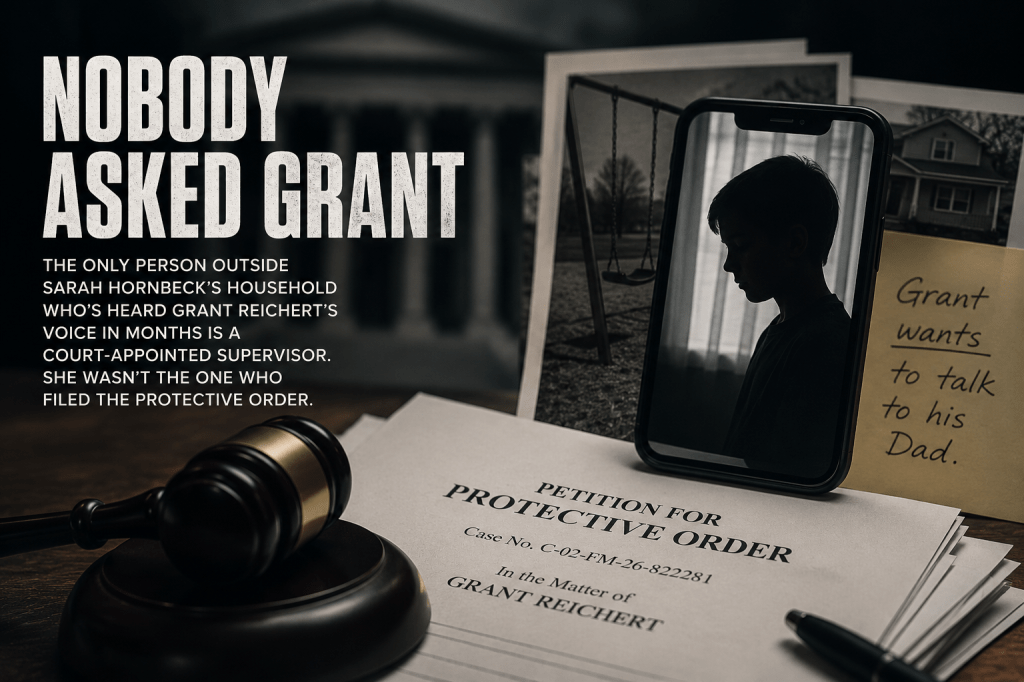
The only person outside Sarah Hornbeck’s household who’s heard Grant Reichert’s voice in months is a court-appointed supervisor. She wasn’t the one who filed the protective order.
A new protective order arrived in Grant Reichert’s name last week, filed by the two adults who control every scrap of contact he has with the outside world. Nobody outside that household can say he asked for it. The one neutral adult who actually has proof of what Grant wants wasn’t asked either — and the record shows exactly why that timing isn’t a coincidence.
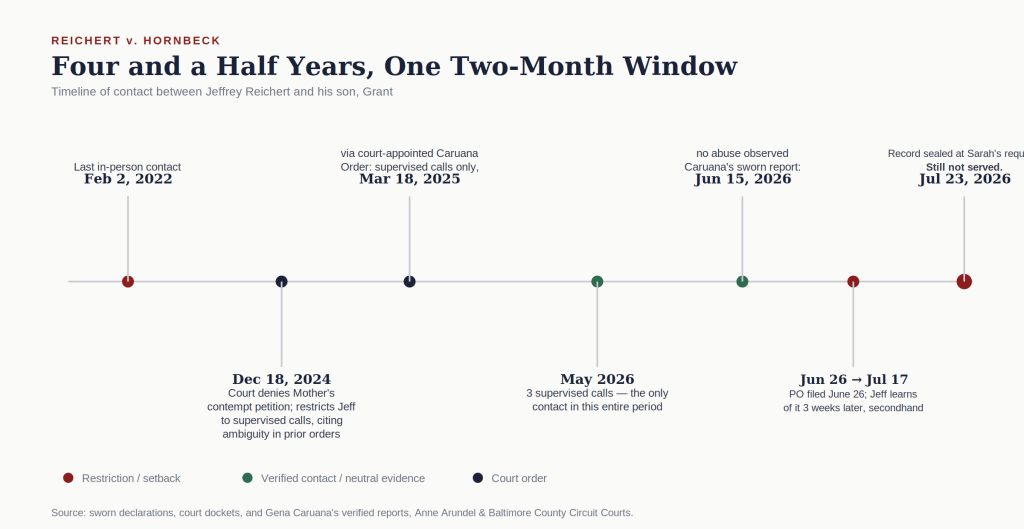
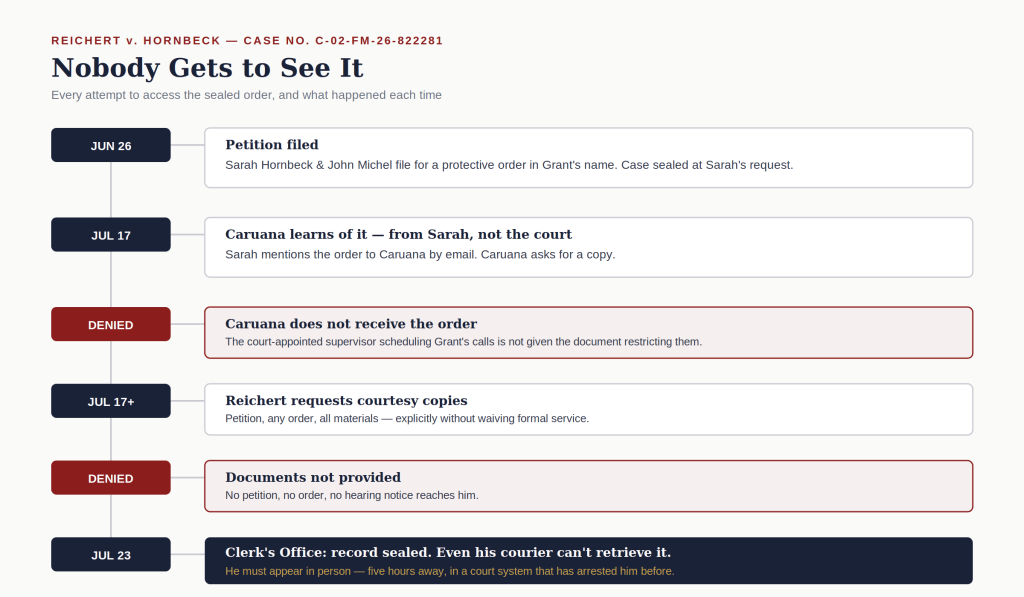
The protective order — Case No. C-02-FM-26-822281, filed by Sarah Hornbeck and John Michel in Grant’s name, reportedly “at Grant’s request” — was filed on June 26, 2026. Jeffrey Reichert didn’t learn it existed until three weeks later, on July 17, and not through service: Hornbeck mentioned it to Gena Caruana, the court-appointed supervisor, in an email. As of July 23, according to Reichert’s own sworn court filing, he still had not been formally served, had not received a copy of the petition, and had not been told what it alleges.
Except one person. And she wasn’t the one who filed the petition.
Reichert has not spoken to his son since three supervised phone calls in May. He has not seen him in person since February 2, 2022. He has no way of knowing what Grant wants, because he has no way of reaching him at all — and neither does anyone else outside Hornbeck and Michel’s household.
Except one person. And she wasn’t the one who filed the petition, and she wasn’t given a copy of it either.
The supervisor the court appointed — and the petition that bypassed her
Gena Caruana has been a professional visitation supervisor for fourteen years. The Anne Arundel court put her in charge of every phone call between Reichert and his son under its March 18, 2025 order. She is not on either parent’s payroll. She has stated, in writing, under penalty of perjury, that she takes no side.
Here is what she swore to, on the record, weeks before this protective order surfaced:
Grant was not abused during any call she supervised. Grant himself picked the time for the next one. Then Hornbeck told her Grant no longer wanted to schedule it — and moved to have Caruana removed as supervisor entirely.
Caruana didn’t accept that at face value. She filed an emergency motion. She testified that scheduling with Hornbeck had become “unusually difficult” and involved “a level of gatekeeping that was not typical” in fourteen years of doing this work. She testified she’d grown concerned Grant “was not free to communicate openly.” She asked the court to step in.
“That’s not what Grant said to me when I last saw him. He gave me a specific time period that he wanted to schedule the next call.”
— Gena Caruana
In emails obtained by Riptide, sent directly to Hornbeck the day before the removal motion, Caruana was blunter still. When Hornbeck suggested Grant himself no longer wanted to talk, Caruana wrote back: “That’s not what Grant said to me when I last saw him. He gave me a specific time period that he wanted to schedule the next call.” She went further: “I agree with you that Grant is an exceptionally intelligent 16.5 year old who is mature and capable of making his own decisions. But if you truly believe that, why are you inserting yourself into the scheduling of his phone calls with his father? Either you think he’s brilliant and mature or you think he’s feeble and requires protection from phone calls he chose to continue. Pick a lane because the dichotomy is confusing and lacks credibility.” She called the shifting explanation what it looked like to her: “The ever changing narrative reads like lies AND that you have an agenda that goes against what the court ordered.”

Hornbeck’s own email the day before is what triggered that response: “Grant does not wish to schedule a supervised call at this time, and I am not going to force him to do so, but I will let you know when he does.” Weeks later, instead of that call being scheduled, the protective order arrived.
Three weeks later, instead of a hearing on Caruana’s motion, a protective order appeared.
Three weeks later, instead of a hearing on Caruana’s motion, a protective order appeared — not filed by Caruana, not verified by any neutral party, and disclosed to Reichert only after Caruana moved to arrange the very call Hornbeck now says Grant doesn’t want.
Nobody has explained how those two facts fit together. Nobody in a position to answer has tried.

Sealed, unserved, and already in effect
When Caruana learned of the order secondhand, she asked Hornbeck for a copy. She didn’t get one. When Reichert himself asked for courtesy copies of the petition and any order — without waiving formal service — he didn’t get those either.

On July 23, he called the Anne Arundel County Clerk’s Office directly. He was told the case record had been sealed at Hornbeck’s own request, that his authorized courier would not be permitted to retrieve it, and that he would have to appear in person at the courthouse — roughly five hours from where he lives in Chesapeake, Virginia — to inspect a document he still hasn’t been told the contents of. Reichert has previously been arrested and detained in proceedings connected to this same litigation; in a sworn petition filed the same day, he states that an unexpected law-enforcement encounter is a documented trigger for his PTSD.
Respondent cannot prepare a defense to allegations he has not been permitted to read.
None of that has stopped the order from having an effect. By his account, Hornbeck has already cited the sealed, unserved petition to end the supervised-call process entirely, told Caruana not to contact her or Grant again, and moved to replace Caruana as supervisor — without first getting the custody order that specifically named Caruana modified. Reichert, for his part, states under oath that he’s voluntarily staying away from Grant altogether rather than risk violating terms he isn’t allowed to read.
A protective order that neither the respondent nor the court-appointed supervisor can see is already reshaping who has access to a 16-year-old. That’s true regardless of what the order eventually turns out to say.
A second witness, a longer pattern
Caruana isn’t the only person outside Hornbeck and Michel’s household with direct, sworn knowledge of what’s happened to Grant. Carolyn Reichert, Grant’s paternal grandmother, was herself court-identified at one point as a supervisor for contact between Grant and his father — she has firsthand history here, not secondhand impressions.
In a sworn declaration filed in the same Baltimore County case, she states that around late October 2023, she became concerned Sarah was listening to and recording the calls between Grant and his father — and that ordinary contact between them effectively stopped around that same period, more than a year before the December 2024 order that further restricted Jeff to supervised communication only.
Sarah had told him he wasn’t allowed to call his father, and that if he did, his father would go to jail.
In a later conversation, she says Grant told her, in substance, that Sarah had told him he wasn’t allowed to call his father, and that if he did, his father would go to jail. Her declaration puts it in Grant’s own words: Sarah “was not allowed to call and that if he called his father, his father would go to jail.” When she asked Grant directly where he wanted to live, he told her: “he wanted to live with his dad.” When she asked whether his father had ever abused him, Grant answered in a single word: “Never.”
She describes him on later calls as quiet, nervous, and behaving as though he was afraid of being overheard or of consequences for speaking freely.
Her account and Caruana’s come from different periods and different vantage points — Carolyn Reichert describes the longer historical pattern going back to 2023; Caruana describes the present, court-ordered structure in 2026. Together they describe the same shape: a child who, in his own reported words, wants contact with his father and denies being abused by him, and an environment in which he appears afraid to say so freely.
The questions nobody will answer
Reichert’s attorney put it in writing to Hornbeck’s counsel, Brennan McCarthy, the day the filing surfaced: What specific conduct, after the May calls — the only contact Reichert has had with his son in going on two years — does this petition allege? Did Grant personally review the allegations? Is there a signed or recorded statement from him anywhere, or is “at Grant’s request” resting entirely on what his mother says he wants?
McCarthy’s written response did not answer a single one of those questions. It declined to waive service. It criticized Reichert’s litigation history. It told him to get the mental health treatment a court ordered — in 2022. Four years ago.
The only question that matters for a petition like this is what happened recently — recently enough to justify new restrictions on a man who’s had no contact with his son at all outside three supervised calls since 2024.
That’s worth sitting with. The only question that matters for a petition like this is what happened recently — recently enough to justify new restrictions on a man who’s had no contact with his son at all outside three supervised calls since 2024. McCarthy’s answer wasn’t about anything recent. It reached back to an order from a different year, a different stage of the case, already litigated and already complied with, and offered it as if it settled the question of what Grant wants today. It didn’t say Grant reviewed the petition. It didn’t say Grant gave a statement. It didn’t address Caruana’s sworn report at all.
This is what family law researchers and a growing number of state legislatures have started naming directly: litigation abuse. Not any single filing being false or true on its own, but the use of continued litigation itself — reopening settled matters, answering questions about the present with facts from the past — as a way to extend restrictions and exhaust the other parent without ever engaging the actual question in front of the court. Whether this specific petition qualifies is for a judge to decide. But the mechanism is visible in McCarthy’s own letter: asked what Reichert did recently, the answer was something from 2022.
Asked what Reichert did recently, the answer was something from 2022.
It isn’t the first time a filing against Reichert has come up empty on scrutiny. A prior protective order Hornbeck filed against him in Anne Arundel County was rejected outright at its final hearing in February 2024, with the court’s order stating plainly: “THIS ORDER IS DENIED BECAUSE: THERE IS NO STATUTORY BASIS FOR RELIEF.”
Filed while the court already had three motions on its desk
The timing isn’t incidental. When this protective order surfaced, the Anne Arundel court already had three of Reichert’s emergency motions pending — for contempt, for enforcement of the court’s own supervised-call order, and for modification of custody — plus a separate petition, filed through Caruana as Grant’s “next friend,” asking only that a judge speak to Grant directly, outside the presence of every adult currently controlling his access to the outside world.
A protective order stops all of that cold. It doesn’t need to survive a hearing to do it — the mere existence of a new case, filed the same week the old ones were coming to a head, is enough to freeze the calendar and shift every proceeding onto Hornbeck and Michel’s terms.
This is not the first protective order to appear at a moment like this one. It’s the pattern this case has followed since it left Baltimore City for a courthouse in a county neither parent currently calls home. Sarah Hornbeck’s address of record is in Middle River, Maryland — Baltimore County. Jeff Reichert has lived in Chesapeake, Virginia, since at least 2022. Anne Arundel County has continued to preside over this case, issue its orders, and now field this latest protective order, despite neither parent residing within its borders.
Enforced one way, ignored the other
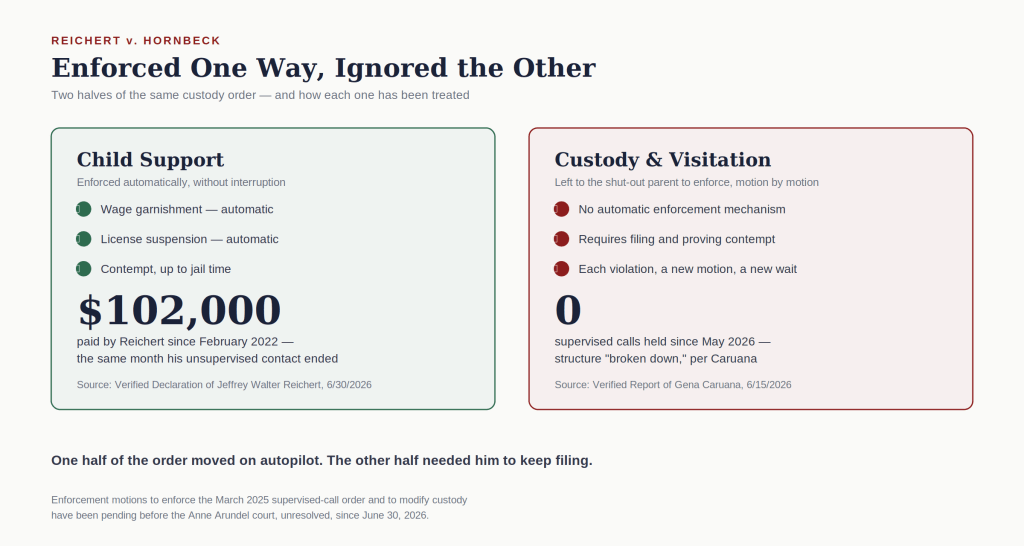
One half of the same order moved on autopilot. The other half needed him to keep filing.
There’s a well-documented asymmetry in family courts nationally: a child support order comes with automatic teeth — wage garnishment, license suspension, contempt proceedings that can end in jail. A custody or visitation order that gets ignored has none of that built in. The parent being shut out has to file, and prove it, and wait, one motion at a time, with no automatic enforcement on the other side.
This case is a clean illustration of it. Reichert states, under oath, that he has paid approximately $102,000 in child support since February 2022 — the same month he last saw his son in person. The support obligation was enforced without interruption. The communication and access side of the same custody order has not been: the March 2025 structure requiring supervised calls has, by Caruana’s own account, broken down, and Reichert’s motions to enforce it and to modify custody have been sitting before the court since June 30, 2026, unresolved.
One half of the same order moved on autopilot. The other half needed him to keep filing.
What this does to a parent
The petition never reached a ruling on whether Grant should be heard. It ran out of runway first.
Reichert’s own attempt to get Grant heard directly — a petition for emancipation, built around exactly the question Caruana is now raising — didn’t survive procedurally long enough to be decided on its merits. Judge Elizabeth S. Morris, who presided over the case, denied his request for an emergency hearing in January 2025, denied a renewed request in March, and denied his motion to have her recused from the case in May.
In February 2026, his entire legal team was struck as counsel over unpaid fees the same week the court warned that nonpayment could result in dismissal; the case was voluntarily dismissed the next day, with Reichert ordered to cover the remaining costs. The petition never reached a ruling on whether Grant should be heard. It ran out of runway first.
Not losing on the merits, just losing the ability to keep litigating.
That kind of outcome — not losing on the merits, just losing the ability to keep litigating — is a documented feature of what researchers call the experience of a “targeted parent.”
A 2020 study by Lee-Maturana and colleagues in the Journal of Child and Family Studies, based on interviews with 54 parents who had experienced this kind of estrangement, found consistent patterns of depression, anxiety, and trauma symptoms, and reported that 23% of the parents interviewed had attempted suicide. The sample wasn’t random — it was parents who sought out the study — so the number isn’t a claim about how common suicide attempts are among all separated or alienated parents nationally.
What it does show is that among people living through this severely enough to seek out research participation, the risk isn’t rare or hypothetical. The researchers recommended clinicians treat it as a standard thing to screen for in this population, not an edge case.
Discover more from Reform Maryland Courts
Subscribe to get the latest posts sent to your email.
