

In a blistering federal lawsuit that exposes the ugly underbelly of Maryland’s family court system, disabled veteran and attorney Jeff Reichert accuses the Anne Arundel County Circuit Court of deliberately shutting him out of his own custody battle through denied accommodations and outright retaliation.
Filed in late December 2025 and now simmering in U.S. District Court, this case isn’t just about one father’s fight—it’s a savage indictment of a judiciary that preaches access to justice while allegedly trampling federal disability rights.
As the state’s top lawyer, Attorney General Anthony Brown— a self-proclaimed champion of civil rights—finds himself in the hot seat, potentially tasked with defending a system his own office has vowed to reform.
This story builds on ongoing investigations into Reichert’s tangled web of lawsuits, including our recent public records requests probing government communications about his cases.
With hearings grinding on without Reichert’s input and a history of what he calls “bogus protective orders,” this ADA showdown could force Maryland to confront whether its courts are havens for the vulnerable or echo chambers for institutional bias.
Background on the Case: A Custody Battle Turned Civil Rights War
Jeff Reichert, a Chesapeake, Virginia-based lawyer with Maryland bar credentials, isn’t your typical pro se litigant. Suffering from post-traumatic stress disorder (PTSD) and traumatic brain injury (TBI)—conditions that substantially impair his ability to engage in high-stress, adversarial proceedings—Reichert has been locked in a protracted family dispute in Anne Arundel County since at least 2022.
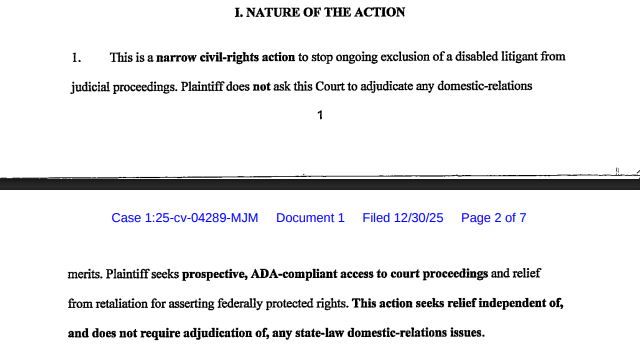
The underlying case, C-02-FM-25-000493, involves custody and visitation with his child, but Reichert’s federal complaint meticulously avoids delving into those merits, focusing instead on the court’s alleged failure to provide “reasonable accommodations” under Title II of the Americans with Disabilities Act (ADA).
Removed to federal court on December 27, 2025, under 28 U.S.C. §§ 1441 and 1446, the suit names the Anne Arundel County Circuit Court, its Chief Administrative Judge (in official capacity), and unnamed Court Administration/ADA Officials as defendants.
Reichert seeks declaratory and injunctive relief to halt ongoing exclusions and restore his access, arguing that the state proceedings raise substantial federal questions about disability discrimination.
This isn’t Reichert’s first rodeo in federal court. Related dockets reveal a pattern: Reichert v. Reichert et al. (1:25-cv-04155), removed in December 2025, and Reichert v. Hornbeck et al. (1:26-cv-00188), filed in January 2026, both alleging civil rights violations tied to the same family saga.
Independent reporting from outlets like MDBayNews highlights a “frightening history” of court interactions, including demands for in-person appearances that Reichert claims exacerbate his disabilities.
The Reform Maryland Courts initiative, through freegrantreichert.com, chronicles a timeline stretching back to 2004, riddled with protective orders, emancipation battles, and accusations of domestic violence manipulation.
At the heart of it? Reichert’s repeated requests for simple fixes like remote participation or adjusted hearing formats, denied over a year across multiple sessions. As hearings plowed ahead without him, the court issued written denials and even barred future ADA submissions—actions Reichert brands as “intentional discrimination and deliberate indifference.”
The Allegations: Discrimination, Retaliation, and a System Rigged Against the Disabled
Reichert’s complaint pulls no punches: For over 12 months, the Anne Arundel Circuit Court has “proceeded without Plaintiff’s participation” after rejecting accommodations essential for his “meaningful access” to judicial proceedings. With PTSD and TBI limiting major life activities like concentration and emotional regulation in confrontational settings, Reichert argues these denials violate 42 U.S.C. § 12132, the core of ADA Title II, which mandates public entities like courts to provide equal access to qualified individuals with disabilities.
But it gets worse. In a move reeking of retaliation, the court allegedly issued determinations not just denying requests but prohibiting further ADA filings—while simultaneously advancing the case. This, Reichert claims, breaches 42 U.S.C. § 12203, the ADA’s anti-retaliation provision. “Federal intervention is necessary to prevent irreparable harm,” the filing states, painting a picture of a judiciary more interested in silencing dissent than upholding rights.
Supporting documents, including an emergency motion for a temporary restraining order (TRO), amplify the outrage. Reichert’s bid for immediate relief cites “ongoing exclusion” and seeks to pause state proceedings until accommodations are granted.
Recent updates suggest the court doubled down, demanding personal appearances despite federal accommodations in parallel cases—a tactic that critics say smacks of entrapment, given Reichert’s history of “bogus” protective orders filed against him, leading to potential detentions.
This isn’t isolated. Reichert’s broader allegations, echoed in related suits, point to a pattern of bias: ex parte communications, misuse of protective orders, and failures to address disabilities in custody decisions. A 2025 custody order, for instance, granted sole custody to the mother (Sarah Hornbeck), barred in-person access for Reichert due to “child’s well-being” concerns, and mandated supervised communication—decisions made amid denied accommodations.
Advocacy groups might see this as emblematic of how family courts nationwide sideline disabled parents, but in Maryland, it’s a powder keg waiting to explode.
The Tie to Attorney General Anthony Brown: Hypocrisy or Hardball Defense?
Enter Anthony Brown, Maryland’s Attorney General since 2023, whose office is poised to represent the state defendants in this federal fray. Brown’s civil rights record is a masterclass in progressive posturing: He’s co-authored guides on protecting rights against discrimination, opposed Trump-era rollbacks on gender-affirming care (which he ties to disability protections), and fought for oversight in special education to combat racial disparities—often extending to disabilities.
In July 2025, Brown and the Maryland Commission on Civil Rights released a “Know Your Rights” booklet emphasizing protections for people with disabilities in public accommodations—including courts.
He’s sued over voter data privacy, highlighting disability status as sensitive information, and joined coalitions defending ADA interpretations. “Every Marylander… deserves to be seen, heard, and protected,” Brown has proclaimed.
Yet, as AG, Brown’s duty is to defend state entities like the Anne Arundel Circuit Court against civil rights claims—even when they clash with his rhetoric. This irony isn’t lost on observers: Will Brown aggressively litigate to shield a court accused of the very discrimination his office decries? Or will internal probes, like those MDBayNews has requested, reveal discomfort within his ranks?
Critics savage this as hypocrisy. Brown’s Civil Rights Division, launched in 2024 to enforce anti-discrimination laws, could theoretically investigate such claims—but defending the accused flips the script.
In a state where Disability Rights Maryland routinely battles for equal access (as in their January 2025 suit against the Maryland Department of Health for indefinite detentions of incompetent-to-stand-trial detainees), Brown’s role here could tarnish his legacy.
Broader Implications for Maryland’s Judiciary: A Call for Reform?
Reichert’s suit isn’t just personal—it’s a referendum on Maryland’s courts. With ADA complaints rising nationwide, Anne Arundel’s alleged stonewalling highlights systemic flaws: Overburdened judges, inadequate training on disabilities, and a family court culture that prioritizes speed over equity. As Thunder Report’s ongoing “Reichert Files” investigation notes, the pattern of denied accommodations amid protective order abuses raises serious concerns about entrapment and bias. They come across as further attempts to have him detained.
This echoes broader critiques, like those from Reform Maryland Courts, which documents protective order abuses and calls for special masters in biased cases.
If Reichert prevails, it could mandate statewide ADA overhauls, forcing courts to accommodate remote access routinely— a boon for disabled litigants but a logistical nightmare for traditionalists.
Public trust hangs in the balance. With no X chatter yet on this specific case, the story’s virality potential is high, especially if Brown’s defense strategies leak. MDBayNews’ records requests aim to uncover just that: Emails, memos, anything showing how state players view Reichert’s claims.
Conclusion: Justice Delayed, Rights Denied—Time for Accountability
Jeff Reichert’s ADA bombshell lays bare a Maryland court system’s alleged contempt for federal protections, retaliating against a disabled father daring to demand access. As the case advances in federal court, all eyes turn to AG Anthony Brown: Will he uphold his civil rights mantle or become the shield for institutional failure?
This isn’t abstract—it’s a strong reminder that in the fight for justice, the disabled are too often left outside the courthouse doors. MDBayNews will continue digging; stay tuned for updates as records roll in.
Discover more from Reform Maryland Courts
Subscribe to get the latest posts sent to your email.
