
Understanding the District Court Commissioner System
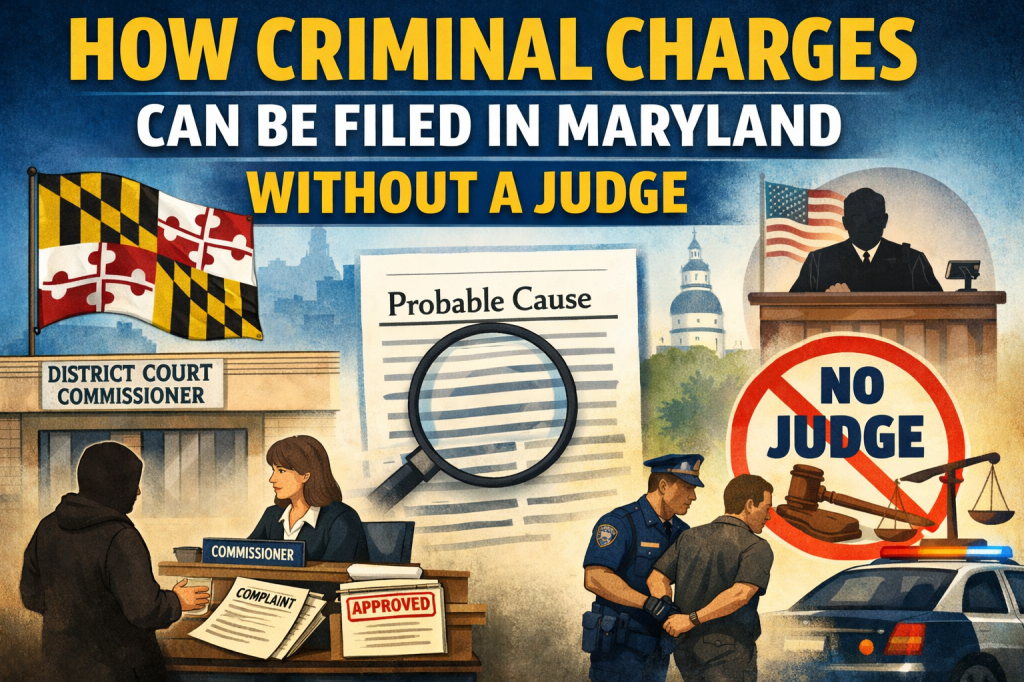
When most Americans imagine someone being charged with a crime, they picture a judge reviewing evidence in a courtroom before issuing charges. In Maryland, however, many criminal charges begin through a different process—one that often takes place outside a courtroom and without both parties present.
That process involves District Court commissioners, judicial officers who have the authority to issue charging documents during initial criminal proceedings. The system is designed to allow criminal complaints to be processed quickly, particularly after hours or when courts are closed. But critics argue that the structure can also create situations where charges are issued based primarily on one person’s sworn statement.
Understanding how the commissioner system works helps explain why disputes sometimes arise over the evidence that existed at the moment criminal charges were filed.
What Is a District Court Commissioner?
In Maryland, District Court commissioners are judicial officers appointed by the Chief Judge of the District Court. Their role is to handle certain initial stages of the criminal process, including:
- Reviewing applications for criminal charges
- Determining whether probable cause exists
- Issuing statements of charges
- Advising arrested individuals of their rights
- Setting initial conditions of release or bail
Commissioners operate 24 hours a day, seven days a week, often from commissioner stations located in courthouses, detention centers, or police facilities.
Their role is intended to ensure that the criminal justice system can function continuously—even when courts are closed.
How Criminal Charges Can Begin
In Maryland, criminal charges can be initiated in several ways. One common path begins when a person files an Application for Statement of Charges with a commissioner.
The process generally works like this:
- A complainant submits a written application describing alleged criminal conduct.
- The commissioner reviews the application and may ask the complainant questions.
- The commissioner decides whether the information establishes probable cause.
- If probable cause is found, the commissioner may issue a Statement of Charges and either:
- issue a summons, requiring the accused to appear in court later, or
- issue an arrest warrant.
This initial review is typically conducted ex parte, meaning only the complainant is present. The accused person does not participate in that stage of the process.
What Is “Probable Cause”?
To issue charges, a commissioner must determine that probable cause exists.
Probable cause is a legal standard requiring a reasonable basis to believe that:
- a crime occurred, and
- the accused person committed it.
It does not require proof beyond a reasonable doubt. It also does not require the same level of evidence that would be presented during a trial.
Instead, commissioners often rely heavily on the complainant’s sworn statement and any supporting materials submitted with the application.
Why the Process Is Ex Parte
The commissioner process is designed to move quickly and efficiently. Because it occurs before formal court proceedings begin, it typically involves only the person making the complaint.
The accused person has an opportunity to respond later—during court hearings or trial—but not at the moment charges are initially issued.
Supporters of the system argue that this structure allows victims to seek protection or initiate criminal complaints without unnecessary delays.
Critics argue that the ex parte nature of the process means commissioners sometimes rely on one-sided information when making the initial probable cause determination.
Are Commissioners Always Attorneys?
In Maryland, commissioners are judicial officers, but they are not always required to be licensed attorneys. They receive training for their role and operate under the authority of the Maryland judiciary.
Because they are not judges and often operate outside formal courtroom settings, the commissioner system sometimes draws scrutiny from legal reform advocates who argue that important charging decisions should involve stricter evidentiary review.
What Happens After Charges Are Issued?
Once a commissioner issues charges, the case moves into the regular court process.
The accused person is then entitled to:
- receive notice of the charges
- appear before a judge
- challenge the evidence
- request dismissal if the charges lack legal or factual support
Prosecutors also review charges in many cases and may decide whether to pursue or dismiss them.
The commissioner’s decision is therefore not the final determination of guilt or innocence—it simply begins the formal legal process.
Why the System Sometimes Becomes Controversial
The commissioner system has existed for decades and handles thousands of applications each year. Most cases proceed through the courts without controversy.
However, disputes occasionally arise when litigants later question what information was presented to the commissioner when charges were issued.
In civil lawsuits involving claims such as malicious prosecution, courts may examine whether probable cause existed at the time criminal charges were filed. That inquiry can involve reviewing the statements, documents, and evidence that were—or were not—presented during the initial charging application.
Because the commissioner process occurs outside a traditional courtroom and often without a full evidentiary record, reconstructing exactly what information was reviewed can sometimes become a point of legal dispute.
A System Designed for Speed
Ultimately, Maryland’s commissioner system exists to ensure that criminal complaints can be processed quickly and continuously.
It allows charging decisions to occur:
- outside normal court hours
- without waiting for a judge
- based on sworn complaints reviewed by trained judicial officers
For supporters, that efficiency is essential to the functioning of the justice system.
For critics, the ex parte structure raises questions about how thoroughly evidence is evaluated before charges are issued.
Understanding how the commissioner system works helps illuminate why disputes over probable cause—and the evidence supporting it—sometimes become central issues in later court proceedings.
Discover more from Reform Maryland Courts
Subscribe to get the latest posts sent to your email.
