

In a move that reeks of desperation and tactical deflection, Sarah Hornbeck has filed a Motion to Dismiss (MTD) in the federal malicious prosecution case Reichert v. Hornbeck (Civil Action No. 1:26-CV-00188-SAG), dated March 6, 2026—just days after her February 27, 2026 deposition where she crumbled under questioning, where she repeatedly admitted she could not recall the communications she relied on when filing criminal charges and could not say whether the alleged threatening texts were ever shown to a commissioner.
This isn’t a coincidence; it’s a savage scramble to bury the fallout from a deposition that exposed her alleged manipulations, contradictions, and ethical lapses as a Maryland attorney.
As the dust settles on her testimony—riddled with backpedaling that could invite perjury scrutiny—Hornbeck’s MTD attempts to slam the federal door shut, invoking res judicata and immunity to evade accountability in a 15-year custody war that’s left her ex-husband, Jeff Reichert, alienated from their son Grant since 2022.

A Deposition That Raised Serious Questions
The timing couldn’t be more telling.
Fresh off a deposition that painted her into multiple corners—testimony that raised questions about the nature of the alleged threats underlying her filings—Hornbeck rushed to file a motion to dismiss, as if hoping to outrun the revelations before they ignite broader calls for disbarment.
When pressed to identify specific conduct that allegedly frightened her during the July–August 2020 incidents, Hornbeck testified that any communication from Reichert was terrifying — even something as simple as a greeting.
Counsel: “So even if he says, ‘Hello, Sarah,’ you are terrified?”
Hornbeck: “Yeah, pretty much.”
This MTD, drafted by her counsel Brennan C. McCarthy, isn’t a confident counterpunch. It reads more like a frantic firewall—desperately clinging to prior state court wins that themselves raise eyebrows for bias and rubber-stamping.
Maryland’s family courts have long been accused of favoritism toward accusers like Hornbeck, and this filing only amplifies the stench—prolonging a saga where a father’s rights are trampled while procedural shields protect the accuser.
The Motion’s Flimsy Foundations
Res Judicata as a Shield for Deception
The deposition matters for more than its timing.
The questioning repeatedly exposed what may be the central problem for Hornbeck’s defense: the collapse of the factual basis for the criminal charges that triggered the entire chain of events.

When asked what communications she relied upon when seeking charges, Hornbeck repeatedly testified she could not recall the specific messages and could not say whether the alleged texts were even shown to the commissioner who approved the charges.
The Commissioner System
That uncertainty highlights a broader feature of Maryland’s criminal charging process.
In many jurisdictions, initial charges are issued by district court commissioners during ex parte proceedings, where only the complaining witness appears and the accused has no opportunity to respond.
Commissioners are judicial officers but are not always required to be attorneys, and the process often relies heavily on the complainant’s sworn statement rather than live evidentiary review.
Critics of the system argue that this structure can allow criminal charges to be issued based on incomplete or one-sided presentations of events.
What the Motion Argues
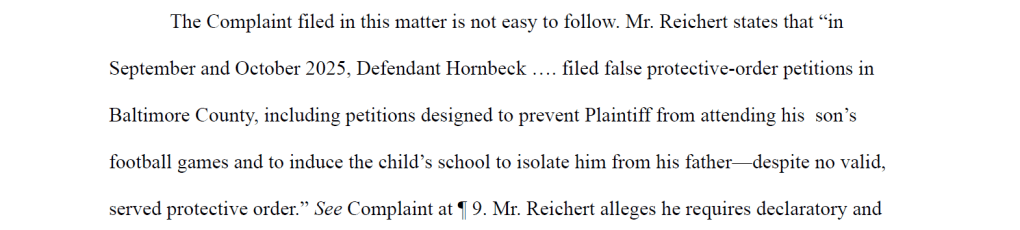
Hornbeck’s 12-page Motion to Dismiss opens with a procedural recap (pages 1–2), positioning this as Reichert’s “second frivolous complaint” in federal court and linking it to their Anne Arundel custody order dated March 19, 2025.
In one of the most striking passages of the filing, Hornbeck’s attorney characterizes Reichert as a “vexatious” and “obsessive” litigant and asks the federal court to dismiss the case entirely as frivolous. The unusually aggressive language underscores the intensity of the legal battle between the former spouses and signals that the defense is attempting to frame the federal lawsuit not merely as flawed, but as an abuse of the judicial system itself.
That order:
- Grants Hornbeck sole physical and legal custody
- Denies Reichert any in-person access to his son
- Finds “no likelihood of abuse” by Hornbeck
- Warns that Reichert could cause “further damage” to the child’s well-being
The order also requires Hornbeck to share provider information but bars Reichert from decisions, enforcing no contact while leaving supervised therapy entirely at Hornbeck’s discretion.
In the filing, Hornbeck’s attorneys argue the complaint fails as a matter of law under Rule 12(b)(6), asserting that Reichert has not plausibly established the elements required for malicious prosecution. The motion also argues that many of the issues raised in the federal complaint were already addressed in prior Maryland proceedings and therefore cannot be relitigated under the doctrines of res judicata and collateral estoppel. Additionally, the defense contends that the claims are barred by Maryland’s statute of limitations for tort actions.
Why the Motion May Be Vulnerable
Critics say the motion is built on quicksand.

Hornbeck’s attorneys rely heavily on res judicata and collateral estoppel, arguing the issues were “litigated or could have been litigated” in state court.
But Reichert’s federal lawsuit targets something different:
The alleged malicious criminal filings in 2020—not the custody order itself.
The deposition testimony now raises questions about what evidence actually existed when those criminal charges were pursued.
Why invoke a year-old custody order now unless the deposition testimony threatens to unravel the factual narrative behind those charges?
The Telling Timing
Post-Deposition Desperation or Calculated Cover-Up?
It is difficult to ignore the timing.
Hornbeck filed the Motion to Dismiss just days after her deposition.
During the questioning, she was confronted with emails, petitions, and alleged threatening communications that formed the basis of the criminal filings.
The exchange revealed striking uncertainty about the evidence itself.
At one point, she claimed the messages contained threats:
“It’s coming very soon and very hard.”
But when asked what the texts were about:
“Don’t know. Just Mr. Reichert being Mr. Reichert to the best of my recollection.”
Key Admissions From the Deposition
The testimony highlighted several notable points:
- She cannot recall what communications she relied on when filing charges against Reichert
- She cannot say whether the texts were shown to the commissioner
- She cannot say what any of the texts from Reichert were about
- She claims any communication with Reichert is terrifying
- Even a simple greeting is terrifying
But the most significant moment in the deposition may have been far simpler.
When asked what communications she relied upon when seeking criminal charges against Reichert, Hornbeck testified she could not recall the specific messages and could not say whether the alleged text messages were even shown to the commissioner who approved the charges.
In malicious prosecution cases, the existence of probable cause often turns on exactly that question:
What evidence was presented when the charges were filed?
The Football Game Allegation
During questioning, Hornbeck also referenced a football game where she claimed Reichert appeared “in violation of the court’s custody order.”
The deposition did not establish:
- whether Hornbeck and Reichert interacted
- whether she personally saw Reichert approach their son
- what actually occurred during the game
The testimony raised additional questions about how the alleged incident was reported and interpreted.
The Human Toll
Locking Out a Father While Evading Scrutiny
The Motion to Dismiss attempts to shut down the federal case entirely.
Meanwhile, the custody order continues to keep Reichert locked out of his son’s life.
Grant, now 16 years old, has not seen his father since 2022 despite Reichert’s previously clean record as a veteran and youth coach.
The order grants Hornbeck sweeping control while leaving Reichert with no direct contact.
A Broader Pattern?
Critics argue the case illustrates broader problems in Maryland’s family-court system.
Thousands of protective orders are issued annually, many granted initially through ex parte proceedings where only one side is heard.
In contentious custody disputes, those orders can become powerful strategic tools.
Reichert’s supporters argue that is exactly what happened here.
The Political Irony
Adding another twist to the saga is Reichert’s background.
He has connections to the Judge Advocate General (JAG) community, including ties within Maryland’s legal and military circles.
Supporters say the irony is striking: a system meant to deliver justice now appears stacked against someone who once served it.
Broader Critique: Maryland’s Court Cronyism
The Motion to Dismiss has now shifted the battle to federal court.
If the judge allows the case to proceed, Hornbeck’s deposition testimony could become central evidence in a malicious prosecution claim—and potentially trigger scrutiny under Maryland’s Rules of Professional Conduct.
Critics say the case reflects a deeper problem:
A court system where procedural defenses often shield powerful insiders while ordinary parents struggle to be heard.
Conclusion
“See Through the Stall”

Hornbeck’s post-deposition Motion to Dismiss may ultimately prove to be a strategic miscalculation.
Rather than burying the deposition, it has drawn renewed attention to the very testimony her legal team may have hoped would fade quietly into the record.
If the deposition testimony is accurate, the question for the federal court is not merely whether the case should proceed—it is whether the criminal charges that triggered years of litigation were ever supported by verifiable evidence in the first place.
The central question now facing the federal court is simple:
Should the case be dismissed before evidence is examined—or allowed to proceed so those questions can be tested in court?
For Reichert and his supporters, the answer is obvious.
They are calling for the court to see through what they describe as a procedural stall tactic and allow the case to move forward.
Follow updates:
fatherand.co
freegrantreichert.com
thunderreport.com
Discover more from Reform Maryland Courts
Subscribe to get the latest posts sent to your email.
