
Hornbeck’s Backtracking on ‘Threats’ That Led to False Arrests and a Lost Fatherhood
In a bombshell February 2026 deposition, Sarah Hornbeck—defendant in a federal malicious prosecution suit—crumbled under questioning, admitting her 2020 protective order claims against ex-husband Jeff Reichert may have been “misinterpreted” or lacking “imminent harm.” These “baseless” accusations have stripped Reichert of his son Grant for years, fueling a custody war that’s emblematic of Maryland’s family court pitfalls.
This isn’t just a bitter divorce gone wrong; it’s a glaring indictment of a system that rubber-stamps flimsy allegations, enabling vengeful parents like Hornbeck to weaponize the courts while fathers like Reichert are left in the dust, desperately pleading for scraps of access to their own children.
Hornbeck, a supposed pillar of the legal profession, emerges from this transcript as a pathetic manipulator, her testimony a tangled web of lies and evasions that exposes her as unfit to wield the power of the bar. Her deposition isn’t a defense; it’s a disgrace, a savage self-portrait of a woman who allegedly twisted the law to exact revenge, leaving a trail of destruction in a 15-year saga that’s nothing short of legalized parental theft.
The Setup: A Lawyer Grilled on Her Own Lies
Picture this: Sarah Hornbeck, a Maryland-barred attorney with over two decades of legal experience, sitting for a remote Zoom deposition in Jeffrey W. Reichert v. Sarah Hornbeck (U.S. District Court for the District of Maryland). Grilled by plaintiff’s counsel Ibrahim Reyes, she starts strong, affirming her professional knowledge of protective order statutes and the gravity of sworn statements. But as Reyes dives into the exhibits—starting with her July 10, 2020, Petition for Protective Order and Statement of Charges—the cracks appear faster than a poorly built sandcastle at high tide.
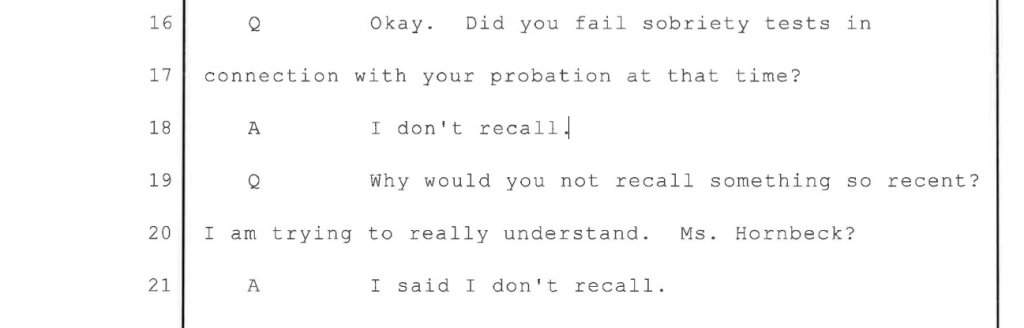
Hornbeck, who graduated from the University of Baltimore School of Law around 2003 or 2004, knows the drill: These filings alleged harassment, threats, and stalking by Reichert, her ex since their 2011 divorce. Yet, under oath, she hedges like a politician dodging a scandal, her “I don’t recall” responses reeking of selective amnesia designed to dodge accountability.

This deposition, spanning 150 brutal pages, lays bare Hornbeck’s alleged scheme: A pattern of exaggerated claims that led to Reichert’s unwarranted arrests and his complete alienation from Grant since 2022. As an attorney, Hornbeck should have been the epitome of precision and ethics, but instead, she comes across as a conniving opportunist, exploiting Maryland’s family law loopholes to maintain her iron grip on custody.
The transcript doesn’t just undermine her credibility; it eviscerates it, revealing a woman who allegedly prioritized personal vendetta over parental responsibility, turning the courts into her personal arena for psychological warfare. Maryland families have suffered enough from such abuses of power—Hornbeck’s deposition is a wake-up call, a savage reminder that the system protects the wrong people.
Five Credibility Problems That Jump Out in the Hornbeck Deposition
Depositions are where narratives collide with facts. Under oath, witnesses must move beyond broad accusations and identify specific events, evidence, and timelines.
In Sarah Hornbeck’s deposition, several credibility patterns emerge that lawyers and investigators often scrutinize closely. The issues are not isolated moments — they repeat throughout the transcript.
1. Selective Memory About the Alleged Threats
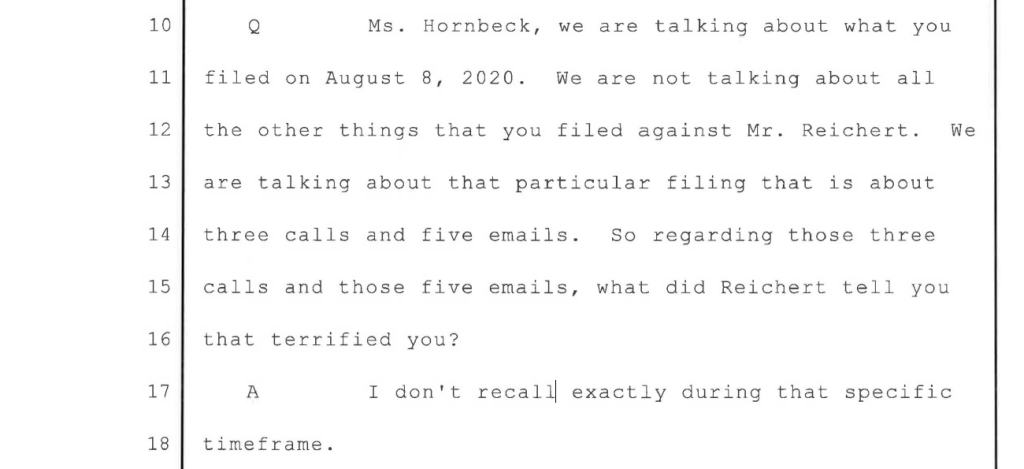
Hornbeck maintains that she was terrified by statements from Jeffrey Reichert. But when asked to identify what those statements actually were, the details disappear.
“What did Reichert tell you that terrified you?”
“I don’t recall exactly during that specific timeframe.”
Even when questioning narrows the focus to three phone calls and five emails, she still cannot identify the language that allegedly caused fear.
“In those emails and calls, he wrote ‘I am coming to get you’?”
“I don’t recall the exact substance.”
For accusations serious enough to lead to criminal charges and protective orders, the absence of identifiable statements stands out.
2. No Ability to Identify the Evidence Used to File Charges
When questioned about the communications that supposedly justified the complaint, Hornbeck acknowledges she cannot identify them during the deposition.
“You are not able to identify the calls, emails or texts at your depo?”
“Correct.”
She also admits she did not possess phone records when the allegations were made.
“You didn’t have those records with you in 2020, did you?”
“No.”
That admission raises obvious questions about what documentation existed at the time the accusations were filed.
3. Uncertainty About What Was Told to the Court
Protective orders rely heavily on what petitioners tell court commissioners. Yet Hornbeck repeatedly states she does not recall what information she disclosed.
“Did you inform that commissioner about the final consent order from Baltimore City?”
“I don’t recall.”
And when asked about another potentially relevant order:
“Did you inform that commissioner about the protective order against you at that time?”
“I don’t recall.”
Pressed further, she confirms:
“So you don’t know whether you told him or you did not tell him. Correct?”
“Correct.”
Those disclosures can be critical to whether a commissioner had a complete picture.
4. Broad Allegations Without Specific Incidents
At points in the deposition, Hornbeck describes Reichert using sweeping language.
“He is extremely disturbed and unstable… he is coming to get me… he is an abuser.”
But when attorneys ask her to identify the specific statements or events supporting those descriptions, the testimony returns to uncertainty and lack of recollection.
Courts typically rely on specific acts and verifiable statements, not generalized character descriptions.
5. Reversals During Testimony
Another credibility issue arises when answers change moments later.
Initially, Hornbeck says Reichert had not seen his son since early 2022.
“Has Mr. Reichert seen his son since February 2, 2022?”
“No. I don’t believe so.”
But seconds later, she corrects herself:
“Oh, wait… yes… one time… in September of 2022.”
Corrections happen in depositions. But when they involve key facts about custody and contact, they can raise questions about accuracy and reliability.
The Pattern
Individually, any one of these issues might be explained as a memory lapse.
Taken together, however, the deposition reveals a recurring pattern:
- accusations without specific statements
- missing or unidentified evidence
- uncertainty about what was told to the court
- generalized claims replacing concrete facts
In litigation, patterns like these often become central to credibility battles at trial.
Core Contradictions: From ‘Escalating Threats’ to ‘Just Angry Emails’
The deposition’s meat—and Hornbeck’s undoing—lies in pages 47-82, where Reyes hammers her on the inconsistencies between her 2020 filings and her current testimony. In those original documents, she painted Reichert as a menacing figure with “escalating threats” that put her in “fear of serious bodily injury.”
“What did he say that made you fear serious bodily harm?”
“I don’t recall the exact words.”
Fast-forward to the deposition, and it’s a different tune: Those communications? “Just angry emails” without the imminent harm required under Maryland Family Law Article § 4-506. She concedes some incidents were “misinterpreted” or “out of context,” effectively gutting the probable cause that led to Reichert’s August 2020 arrest warrants.
This isn’t minor quibbling; it’s a savage self-sabotage. As an attorney, Hornbeck knew—or damn well should have known—the legal thresholds for such orders. Yet here she is, backpedaling like a thief caught in the spotlight, her “I don’t recall” responses on pre-filing consultations smelling of deliberate obfuscation. If these admissions hold, they could torpedo her defense in the federal suit, opening the door to perjury claims and validating allegations of malicious prosecution.
Scathing? Absolutely. This is the kind of legal malpractice that makes you wonder: How many other Maryland families have been shredded by attorneys playing fast and loose with the truth? Hornbeck’s deposition contradictions aren’t innocent lapses; they’re the hallmarks of a calculated deceiver, a woman who allegedly fabricated fear to seize control, leaving Reichert—a disabled veteran with no criminal record—to fight for scraps in a system rigged against him.
The deposition’s deeper dives reveal even more rot. Pages 95-102 scrutinize the arrest warrants, where Hornbeck claims “fear” but concedes “out of context” incidents. Her evasions here are pathetic, a lawyer reduced to stammering denials as the timeline indicts her: Warrants timed with custody hearings, suggesting tortious interference to tip the scales.

Then there’s the email fiasco on page 101, where she admits forwarding partial messages to authorities, omitting context for “emphasis.” This isn’t oversight; it’s evidence tampering, the kind that violates the spirit of ethical practice and screams bad faith. Hornbeck’s performance is a disgrace, a savage display of how privilege and position can corrupt, turning the law into a tool for personal destruction rather than justice.
The Three Questions Hornbeck Could Not Answer Under Oath
Depositions strip away rhetoric and force witnesses to deal in specifics. In the Hornbeck deposition, three simple questions cut to the heart of the accusations that led to arrests, protective orders, and years of father–son separation.
Under oath, she could not answer any of them.
1. What exactly did Reichert say that threatened you?
Hornbeck repeatedly claimed Reichert made statements that caused her to fear serious harm. But when asked to identify the actual words — the specific threat that justified police action and court intervention — she could not do so.
Pressed for details about emails and phone calls she relied on when filing charges, her response was simple: she could not recall the exact language.
2. What evidence did you provide when you filed the charges?
When attorneys asked Hornbeck to identify the texts, calls, or emails she relied upon, she acknowledged she could not identify them during the deposition and did not have phone records at the time the accusations were made.
For allegations that triggered arrest warrants, the inability to point to specific evidence is a glaring gap.
3. What did you tell the court commissioner?
Protective orders hinge on what petitioners disclose to the court. Yet when asked whether she informed the commissioner about prior orders and relevant history between the parties, Hornbeck repeatedly stated she did not recall.
When asked directly whether she had disclosed that information or not, her answer was blunt: she did not know.
Three questions.
Three moments where the foundation of the allegations should have been clear.
Instead, the deposition record shows uncertainty where certainty once fueled arrests and court orders — a contrast that now sits at the center of the federal case.
“You are not able to identify the calls, emails, or texts at your deposition?”
“Correct.”
The Devastating Impact on Custody: Alienation as a Weapon
Hornbeck’s deposition evasions don’t just undermine her credibility; they spotlight the human wreckage of her alleged tactics. Reichert hasn’t seen Grant in person since 2022, despite no court findings of child endangerment against him. The deposition bolsters suspicions of alienation, with Hornbeck dodging questions on the timing of her warrants—conveniently aligned with custody hearings—suggesting a deliberate strategy to sabotage Reichert’s parental rights.
Her current husband, John Michel—a state employee old enough to be Grant’s grandfather—looms as a shadowy figure in this mess, potentially aiding in the isolation that has turned a once-joint custody arrangement into a one-sided lockdown.
“So you don’t know whether you told the commissioner or you did not tell him?”
“Correct.”
Add in her own skeletons: Her 2018 arrest for assault and DUI (mentioned in state appeals) hints at projection, where she accuses Reichert of threats while downplaying her own volatility. She admitted to drinking and drug use.
No wonder suspicions of brainwashing arise—Grant, now 16, remains cut off, despite prior joint custody (per the 2013 appellate opinion granting tie-breakers to Hornbeck). The deposition’s hollow “protecting our child” defenses ring especially false without substantiation, as prior rulings (e.g., 2022 protective order) found no endangerment.
This isn’t innocent parenting; it’s predatory, with Hornbeck allegedly enlisting her family network to fortify the barriers around Grant. The result? A father reduced to wellness checks and distant hopes, his life upended by a woman who allegedly used her legal acumen not for good, but for grudge-fueled gamesmanship.
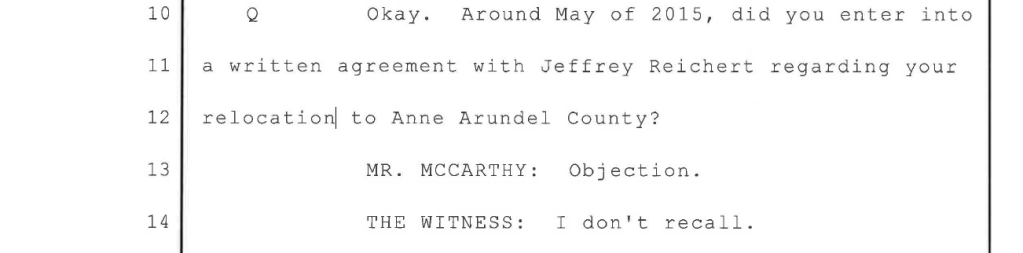
The deposition’s affidavit section (pages 128-141) drives this home: Hornbeck affirms the truth in her own affidavit, but flip-flops on relocation details, admitting “informal agreements” while her narrative paints Reichert as the violator. This guts her claims, turning her sworn statements into a house of cards.
Even her own counsel’s redirects (starting page 134) can’t salvage the mess, highlighting gaps that scream incompetence or worse. Hornbeck’s actions, if as baseless as her deposition suggests, aren’t just petty—they’re pernicious, exploiting Maryland’s family courts to erase a parent and inflict lasting trauma.

Broader Critique: A Rigged System and Calls for Bar Scrutiny
This deposition isn’t an isolated flop; it’s symptomatic of Maryland’s family court farce. The January 20, 2026, unreported appellate opinion in Reichert v. Hornbeck (No. 602-2025, Appellate Court of Maryland) affirmed no ongoing violations by Reichert, yet upheld custody restrictions— deposition fallout that reeks of bias.
Advocacy groups like CourtWatchMontgomery report that protective orders are granted in less than half of final hearings, with many temporary orders issued ex parte on flimsy petitions, allowing misuse in custody battles. Stats from Maryland’s Domestic Violence Monthly Reports show thousands of orders annually, but with denial/dismissal rates nearing 50% at finals, how many like Hornbeck’s slip through the cracks?
As a licensed attorney, Hornbeck’s deposition blunders scream for Maryland Bar review under Rule 3.1 (advancing meritless claims) and 8.4 (misconduct prejudicing justice). Her “emotional” admissions hint at revenge post-2011 divorce—did their out-of-wedlock child fuel a decade-long vendetta? This isn’t lawyering; it’s lawfare, and it’s time for the Attorney Grievance Commission to investigate.
Reichert’s military JAG ties to known political figures in Maryland add irony: A veteran fighting for his son, sidelined by a system that favors the accuser. The broader scandal is Maryland’s venue-shopping sham, where parties will blatantly bounce between counties to find sympathetic judges, prolonging agony and draining resources. Hornbeck’s deposition is the tip of the iceberg—a savage reminder that the system protects manipulators like her, not vulnerable families.
The deposition’s family conspiracy angle adds salacious depth: Subtle references to her parents, Linda and Richard (co-defendants in related suits), suggest multi-generational sabotage, aiding her in interference tactics that have kept Grant isolated. Her new husband Michel’s state role only deepens the intrigue, painting a picture of insider advantages that tilt the scales.
This isn’t a lone actor; it’s a network of enablers, exploiting Maryland’s ethical blind spots to perpetuate alienation. The state’s bar must act—Hornbeck’s deposition demands disbarment, not just dismissal. How many more fathers must suffer before the AGC steps in?
The Transcript Speaks for Itself
In the end, the most striking detail in the Hornbeck deposition is not a single contradiction or admission. It is a phrase that appears again and again across the transcript: “I don’t recall.”
When asked to identify the threats that justified arrest warrants, she could not recall the exact words. When asked to identify the communications that supported the accusations, she could not identify them. When asked whether she disclosed key facts to the court commissioner who issued the protective order, she could not say whether she had done so.
These are not minor details. They are the foundational questions that determined whether a father would be arrested, whether a protective order would be issued, and whether a child would grow up largely without his father.
Now those questions—and the answers that were not given—are preserved in the sworn record.
And the federal court will have to decide what they mean.
“I don’t recall.”
That phrase appears several dozen times in the Hornbeck deposition.
Conclusion: End the ‘Legalized Child Trafficking’—Demand Reform Now
Hornbeck’s deposition debacle isn’t just her downfall; it’s a wake-up call for Maryland’s broken courts. Tease the federal trial ahead in Reichert v. Hornbeck—will her contradictions sink her?
Readers, demand reform: Flood the AGC with calls for ethics probes, support fathers’ rights groups like Fatherand.co, and follow freegrantreichert.com for updates. Maryland families deserve better than this savage charade.
Hornbeck’s deposition isn’t a mere transcript; it’s a manifesto of malpractice, a call to strip her of the license she allegedly abused. The time for accountability is now—before more lives are ruined by her ilk.
Discover more from Reform Maryland Courts
Subscribe to get the latest posts sent to your email.
