
Before Discovery. Before Evidence. Before the Truth Comes Out.
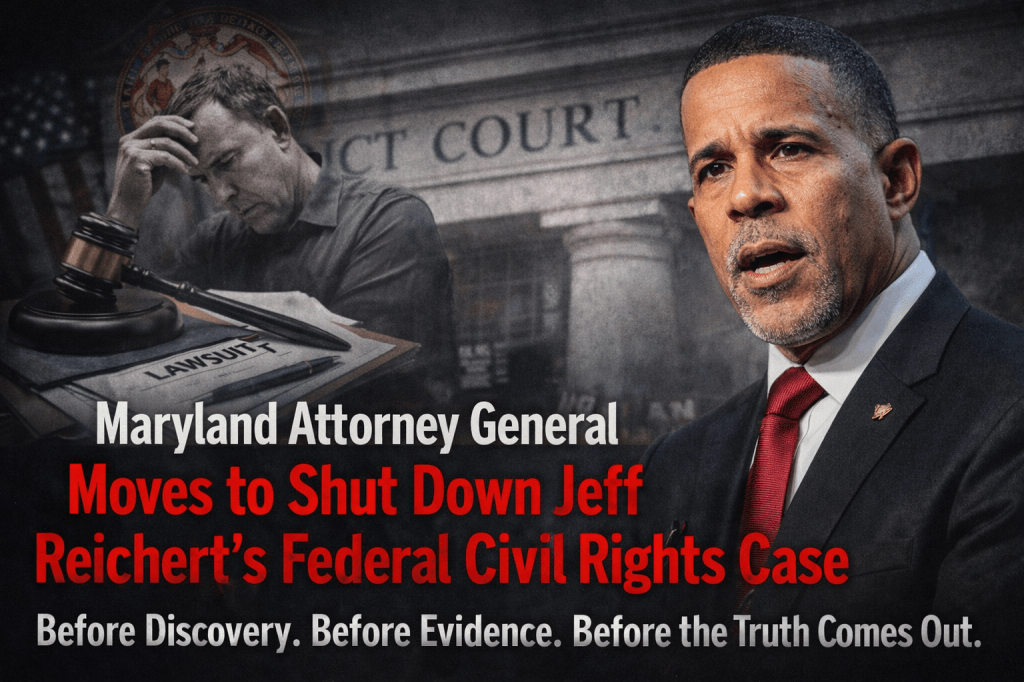
Jeff Reichert has spent years fighting to remain in his son’s life.
Now, as he seeks accountability in federal court, the Maryland Attorney General’s Office is attempting to shut down his civil rights lawsuit before the case even reaches discovery.
The Attorney General’s Office, acting as legal counsel for Assistant State’s Attorney Michelle Demma Fuller, is seeking dismissal at the pleading stage before discovery begins.
The case, removed to the U.S. District Court for the District of Maryland, challenges prosecutorial decisions and court conduct stemming from years of repeated criminal charges, protective order filings, and custody litigation.
Those criminal charges were repeatedly dropped. Several were nolle prossed. Yet the cycle of filings, police contact, and courtroom battles continued.
Now the State is asking the federal court to dismiss the lawsuit under Rule 12(b)(6), arguing that the claims are legally insufficient and that prosecutors are shielded by absolute immunity.
If granted, the case would be dismissed with prejudice — permanently — before Jeff ever has the opportunity to obtain internal communications, charging guidelines, or sworn testimony.
In plain terms: the case could end before the facts are examined.
The Immunity Wall
At the center of the motion is the doctrine of absolute prosecutorial immunity.
This legal shield protects prosecutors from civil liability for decisions made within their prosecutorial role — including decisions to initiate or pursue charges.
Immunity exists to preserve independence. But critics argue it can also prevent accountability when patterns of repeated charges and dismissals raise legitimate questions.
Jeff’s lawsuit alleges constitutional violations, due process concerns, ADA-related claims, and selective enforcement tied to years of legal conflict.
The Attorney General’s Office argues those claims should not move forward.
The federal court must now decide whether Jeff’s complaint states a legally sufficient claim — or whether the courthouse doors close at the pleading stage.
A Pattern That Raises Questions
Public court records reflect a long-running legal history between the parties involving custody proceedings, protective order filings, criminal matters, and appeals.
The pattern Jeff describes is one many parents say they recognize:
- Charges filed.
- Arrests made.
- Protective orders sought.
- Cases later dismissed.
- The cycle restarting.
Even when charges collapse, the consequences remain:
- Time away from children.
- Legal expenses.
- Reputational damage.
- Emotional toll.
- Police presence at one’s home.
Jeff ultimately relocated out of Maryland in an effort to reduce the conflict. The litigation, however, did not disappear.
This federal lawsuit represents his effort to seek judicial review of what he believes was a repeated misuse of prosecutorial and court authority.
The State says the law shields those decisions from civil challenge.
What This Case Really Tests
This case is no longer just about Jeff.
It tests whether:
- Parents can meaningfully challenge patterns of charging decisions tied to custody disputes.
- Immunity doctrine blocks accountability before discovery.
- ADA and constitutional claims can survive against state actors.
- Federal courts will allow factual development when allegations of systemic imbalance are raised.
Rule 12(b)(6) is a powerful procedural tool. It allows dismissal when a complaint fails to state a plausible claim.
But when dismissal occurs at this stage, no emails are produced. No depositions occur. No internal policies are examined.
The story ends before it begins.
Due Process or Deference?
Supporters of prosecutorial immunity argue that it is essential to prevent retaliatory litigation.
Critics argue that when repeated charges result in dismissal — yet the filing cycle continues — trust erodes.
Jeff’s case sits squarely in that tension.
The federal court will decide whether his claims deserve a hearing — or whether the doctrine of immunity bars inquiry altogether.
The Stakes
If the motion to dismiss is granted with prejudice:
- Jeff’s federal claims end permanently.
- No discovery occurs.
- No internal documents are reviewed.
- No sworn testimony is taken.
If any claims survive:
- The case moves into discovery.
- Facts are developed.
- The public record expands.
- The truth is tested.
For Jeff, this is not abstract doctrine.
It is about his ability to defend his name and protect his relationship with his child that has been taken from him.
A Broader Conversation
High-conflict custody disputes are among the most difficult cases courts handle.
The system must protect real victims.
But it must also protect due process.
This case forces a larger question:
When charges are repeatedly dropped, but the consequences continue, does the system contain sufficient safeguards against repetitive legal escalation?
That is not a partisan question.
It is a due process question.
And now, it is a federal question.
Stay Informed. Share the Truth.
This case is about more than one father.
It is about due process, prosecutorial power, and whether citizens can seek accountability in federal court when repeated charges are filed and later dropped.
Here’s how you can help:
✔ Follow Case Updates
Bookmark this site and check back regularly for federal court developments.
✔ Share This Story
If you believe due process matters, share this article with your network.
✔ Stay Engaged
Sign up for updates as new filings, rulings, and court decisions are released.
Transparency matters. Public awareness matters.
And sunlight still matters.
FAQ: What Is Rule 12(b)(6)? (Plain English)
Many supporters have asked what this stage of the case actually means.
Here’s a straightforward breakdown.
What Is Rule 12(b)(6)?
Rule 12(b)(6) is part of the Federal Rules of Civil Procedure.
It allows a defendant to ask a court to dismiss a lawsuit at the very beginning — before evidence is exchanged — if the complaint does not state a legally sufficient claim.
In simple terms:
The court assumes the plaintiff’s factual allegations are true for now — but asks:
“Even if everything alleged is true, does the law allow this case to proceed?”
If the answer is “no,” the case is dismissed.
Does This Mean the Court Has Reviewed Evidence?
No.
At the Rule 12(b)(6) stage:
- No discovery has occurred.
- No depositions have been taken.
- No internal emails have been produced.
- No cross-examination has happened.
The court is only reviewing the complaint and the legal arguments.
What Is Prosecutorial Immunity?
Prosecutorial immunity is a legal doctrine that protects prosecutors from being sued for actions taken as part of their official prosecutorial role.
This includes decisions about:
- Filing charges
- Pursuing charges
- Dismissing charges
Supporters say immunity protects independence.
Critics argue it can prevent accountability.
What Happens If the Motion Is Granted?
If the motion is granted:
- The case could be dismissed with prejudice.
- That means it cannot be refiled.
- The case ends before discovery begins.
No internal records would be examined.
What Happens If the Motion Is Denied?
If the court denies the motion:
- The case moves forward.
- Discovery begins.
- Documents can be requested.
- Depositions can be taken.
- The factual record expands.
Is This a Trial?
No.
This is an early procedural stage.
It determines whether the case survives long enough to reach evidence.
Why This Stage Matters
If cases are dismissed at the 12(b)(6) stage:
- The public may never see internal documents.
- No sworn testimony is taken.
- The story remains limited to pleadings.
That is why this stage is critical.
Discover more from Reform Maryland Courts
Subscribe to get the latest posts sent to your email.
