
Access, Attrition, and the Modern Family Court
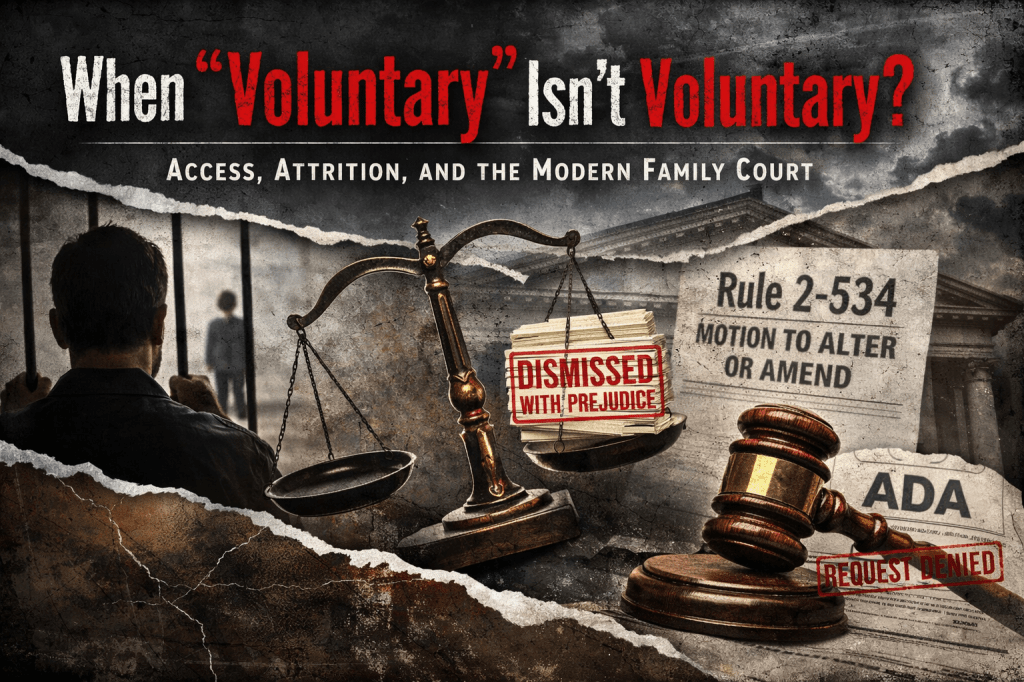
In Reichert v. Hornbeck, Circuit Court for Anne Arundel County, Case No. C-02-FM-25-000493, a voluntary dismissal is now the subject of a Motion to Alter or Amend under Maryland Rule 2-534.
On paper, the sequence appears straightforward:
- A plaintiff files a petition.
- The plaintiff later dismisses the case without prejudice under Rule 2-506.
- The opposing party moves to convert that dismissal to prejudice.
But the word “voluntary” carries weight.
In litigation — particularly in family court — voluntary decisions often occur within structural constraints.
And when those constraints include access concerns, financial pressure, and unresolved accommodation issues, the meaning of “voluntary” deserves closer examination.
The Rule 2-534 Standard Is Narrow
Maryland Rule 2-534 allows a court to alter or amend a judgment in limited circumstances. It is generally invoked to correct:
- Clear legal error
- Newly discovered evidence
- Fraud, mistake, or irregularity
- Extraordinary circumstances
It is not designed to convert a lawful voluntary dismissal into a permanent adjudication substitute simply because one party prefers finality.
In this case, the dismissal was entered under Rule 2-506 without prejudice — a procedural mechanism explicitly intended to preserve the ability to refile before a merits determination.
There was no adjudication.
No trial.
No evidentiary ruling on emancipation.
The burden, therefore, falls on the movants to demonstrate a qualifying ground under Rule 2-534.
Absent such grounds, alteration risks exceeding the narrow scope the rule contemplates.
Access to Court Is Not Peripheral — It Is Foundational
Before dismissal occurred, disability-based access concerns were raised and remote participation was requested under Title II of the Americans with Disabilities Act (ADA), 42 U.S.C. § 12132.
Title II applies to state courts and prohibits exclusion from participation in public services on the basis of disability. Federal regulations require reasonable modifications to policies and procedures where necessary to ensure access, unless doing so would fundamentally alter the proceeding. See 28 C.F.R. § 35.130(b)(7).
Maryland Judiciary policy similarly provides for reasonable accommodation to ensure meaningful access to court proceedings.
Remote participation has become a standard procedural tool in Maryland courts since 2020. Hybrid hearings are technologically feasible and regularly implemented.
When accommodation requests are raised in good faith and remain unresolved at the time of dismissal, the context matters.
Because procedural posture does not develop in a vacuum.
Attrition as Litigation Pressure
Family litigation can impose cumulative pressure:
- Cross-state travel requirements
- Scheduling rigidity
- Ongoing fee obligations
- Repeated adverse rulings
- Access limitations
Any one factor may be manageable.
Together, they can create structural attrition.
Rule 2-506 permits voluntary dismissal to prevent litigants from being forced into premature adjudication when continuation is impractical or strategically unwise.
If dismissal occurs within a landscape shaped by access barriers and litigation fatigue, converting that dismissal to prejudice risks transforming a protective procedural safeguard into a permanent forfeiture.
Rule 2-534 was not designed to function as an attrition amplifier.
The Federal Context
In a separate federal proceeding, ADA-related claims were permitted to proceed beyond the pleading stage. While that case remains pending and does not constitute a final determination on the merits, the court declined to dismiss the disability allegations as implausible or fabricated.
That procedural posture is relevant.
It indicates that the access concerns were not facially frivolous.
When evaluating a motion to alter or amend, courts traditionally consider the broader fairness implications of their rulings.
If dismissal followed unresolved access concerns that survived federal scrutiny, careful analysis is warranted before imposing permanent prejudice.
The Structural Question Before the Court
The issue before Judge Morris is not whether the court has authority under Rule 2-534.
It does.
The question is whether the movants have demonstrated a qualifying legal defect in the dismissal itself.
If no fraud, mistake, or procedural irregularity occurred in the filing of the voluntary dismissal, conversion to prejudice becomes a substantive shift rather than a corrective act.
And where access to court has been part of the litigation environment, fairness concerns become central — not secondary.
Family courts operate at the intersection of procedural discretion and fundamental interests.
When procedural mechanisms begin to determine long-term parental positioning without a merits hearing, scrutiny is appropriate.
Preserving the Purpose of Rule 2-506
Rule 2-506 exists to prevent permanent loss without adjudication.
Its purpose is protective.
If voluntary dismissal — particularly under access constraints — can later be converted into permanent prejudice absent clear error, the rule’s function narrows significantly.
The court’s ruling in Reichert v. Hornbeck will clarify how these rules operate together:
- Rule 2-506’s protection of voluntary dismissal
- Rule 2-534’s limited revisory authority
- And Title II’s guarantee of meaningful access
The outcome will not only affect the immediate parties.
It will signal how Maryland family courts balance access, attrition, and procedural finality in high-conflict cases.
And that balance deserves careful, measured consideration.
Discover more from Reform Maryland Courts
Subscribe to get the latest posts sent to your email.
