
Judge Morris Now Faces Decision In Reichert v. Hornbeck That Could Allow John Michel to Adopt Grant Reichert
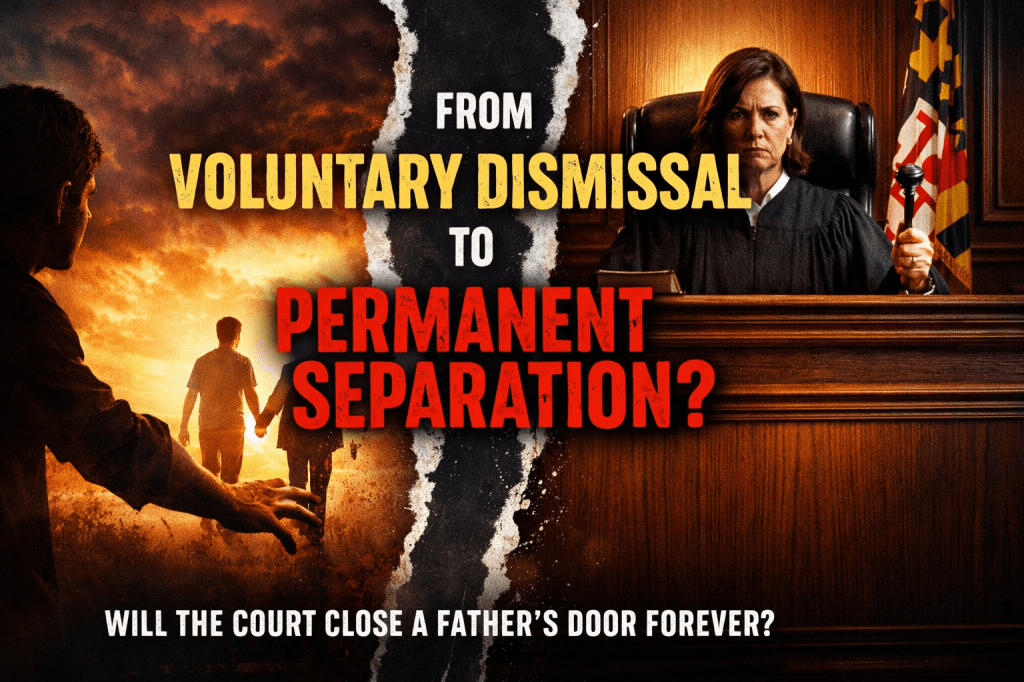
In the Circuit Court for Anne Arundel County, Case No. C-02-FM-25-000493, what began as a procedural dismissal is now at risk of becoming a permanent barrier to Jeff Reichert’s parental claims.
After Jeff Reichert voluntarily dismissed his emancipation petition without prejudice, respondents — including John Michel — filed a Motion to Alter or Amend the Dismissal Order.
That motion now sits before Judge Morris.
If granted, it could convert a voluntary dismissal into a dismissal with prejudice, permanently barring Jeff Reichert from re-litigating the emancipation issue.
In family court, where procedural posture can shape long-term parental rights, that distinction is not technical.
It is decisive.
What the Docket Shows
The public docket reflects the following sequence:
- Jeff Reichert filed the emancipation petition.
- Emergency and related motions were denied.
- Intervention was granted to John Michel.
- A Best Interest Attorney (BIA) was appointed.
- Fee compliance issues were raised.
- Pretrial proceedings were ongoing.
- Jeff Reichert voluntarily dismissed the case without prejudice.
- Within days, respondents moved to alter or amend the dismissal.
There was no merits hearing.
There was no adjudication of parental fitness.
There was no evidentiary finding resolving whether emancipation was proper or improper.
The case ended procedurally — by Reichert’s election under Maryland Rule 2-506.
Respondents now ask the court to change that procedural posture after the fact.
What “Without Prejudice” Is Designed to Protect
Under Maryland Rule 2-506, a plaintiff may voluntarily dismiss an action before final adjudication.
A dismissal “without prejudice” means:
- The case is closed.
- The merits were not decided.
- The plaintiff may refile.
It is a procedural reset.
It is not a defeat.
It is not a ruling against the parent.
It is not a merits determination.
If a voluntary dismissal can later be converted into prejudice absent clear legal error, the protection embedded in Rule 2-506 becomes significantly diminished.
What the Motion to Alter or Amend Requires
Respondents rely on Maryland Rule 2-534, which allows a court to alter or amend a judgment in limited circumstances, typically involving:
- Clear legal error
- Newly discovered evidence
- Fraud, mistake, or irregularity
- Extraordinary circumstances
Rule 2-534 is not designed to convert a lawful voluntary dismissal into a permanent bar simply because one side prefers finality.
The central question before Judge Morris is straightforward:
What legal defect occurred when Jeff Reichert voluntarily dismissed his own case without prejudice?
If no defect exists, altering the dismissal risks transforming a neutral procedural act into a substitute for adjudication.
The Real-World Impact: Adoption and Identity
Granting the motion would not itself finalize adoption proceedings.
But it would materially change the litigation landscape.
If the dismissal is converted to “with prejudice,” Reichert would be permanently barred from reasserting that emancipation claim.
That removal of a live legal issue could strengthen John Michel’s procedural position in any future adoption or name-change proceeding.
It would eliminate pending litigation.
It would narrow legal resistance.
It would reshape future filings.
In family court, procedural doors matter.
When one closes permanently without trial, the consequences extend well beyond paperwork.
The Pattern of Motion Outcomes
The docket reflects that Judge Morris has denied the majority of Reichert’s motions in this litigation.
That observation is not an accusation.
It is a procedural reality reflected in public filings.
Each ruling may be defensible standing alone.
But when viewed collectively — and followed by a post-dismissal motion seeking permanent prejudice — the pattern becomes part of the broader context.
Family courts wield extraordinary discretion.
With that discretion comes the responsibility to avoid even the appearance that procedural mechanisms are being used to reach outcomes not tested on the merits.
Scrutiny in such circumstances is not hostility.
It is accountability.
Rule 2-534 Cannot Be Applied in Isolation: The ADA Context
Before dismissal occurred, Reichert raised disability-based access concerns and requested remote participation under Title II of the Americans with Disabilities Act (ADA), 42 U.S.C. § 12132.
Title II provides:
“No qualified individual with a disability shall, by reason of such disability, be excluded from participation in or be denied the benefits of the services, programs, or activities of a public entity.”
State courts are public entities.
Judicial proceedings are services.
Meaningful access is a statutory requirement.
Federal regulations require public entities to make reasonable modifications to policies and procedures when necessary to avoid discrimination, unless doing so would fundamentally alter the nature of the service. See 28 C.F.R. § 35.130(b)(7).
Maryland Judiciary policy similarly requires courts to provide reasonable accommodations to ensure individuals with disabilities have equal access to court proceedings.
Remote participation has become routine in Maryland courts since 2020. Hybrid hearings are technologically feasible and widely implemented.
The sequence in this case is therefore significant:
- ADA accommodation requested.
- Remote participation not granted prior to scheduled proceedings.
- Litigant voluntarily dismisses.
- Opposing party seeks to convert dismissal to prejudice.
That sequence raises a structural question:
If disability-based access concerns were raised and remained unresolved, can a subsequent dismissal fairly be treated as an unconditional strategic election?
Or must the court consider whether access barriers influenced the procedural posture?
The Federal Court Context
In a pending federal case, Reichert’s ADA-related claims survived challenge at the pleading stage. The federal court declined to dismiss those claims as fabricated or implausible.
This does not constitute a final merits ruling.
But it does establish that the disability allegations were not rejected as frivolous or bad faith at the outset.
That context matters.
If a federal court found the ADA claims sufficiently credible to proceed, a state court should carefully consider those access concerns when evaluating the consequences of dismissal.
Converting the dismissal to prejudice without addressing the access context risks compounding, rather than resolving, a potential structural issue.
The Decision Before Judge Morris
Rule 2-534 requires grounds.
Absent fraud, procedural defect, or irregularity in the dismissal itself, converting the case to prejudice is not a neutral clerical act.
It is a structural decision with long-term consequences.
Judge Morris must now determine whether the motion is grounded in genuine legal error — or whether granting it would transform a voluntary dismissal into a permanent forfeiture under circumstances where ADA access concerns were raised.
Family courts do more than manage dockets.
They shape futures.
They influence identity.
They affect lineage.
When procedural discretion intersects with disability access and parental rights, the standard must be exacting.
What Happens Next
If the dismissal remains without prejudice, the procedural safeguard stands.
If it is converted to prejudice, Reichert’s ability to reassert that emancipation claim ends permanently — and the litigation landscape shifts accordingly.
The ruling will not merely interpret a rule.
It will signal how procedural fairness, disability access, and parental rights are balanced in Maryland family court.
And that balance deserves careful scrutiny.
Editor’s Note:
This article is based on publicly available docket information from the Circuit Court for Anne Arundel County (Case No. C-02-FM-25-000493), applicable Maryland procedural rules, and referenced federal filings. It reflects legal analysis and commentary regarding procedural posture and statutory framework. It does not constitute legal advice, nor does it assert findings beyond what appears in the public record.
Discover more from Reform Maryland Courts
Subscribe to get the latest posts sent to your email.
