
What Reichert v. Hornbeck Reveals About False Accusations, Arrest Power, and Due Process
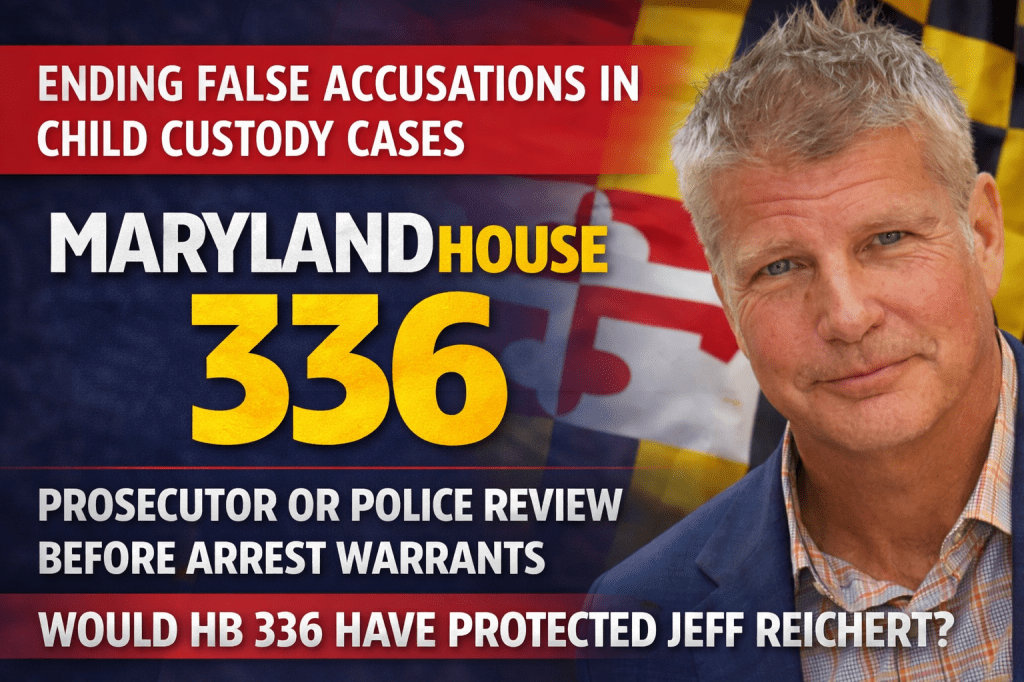
For parents trapped in prolonged custody disputes, the most damaging weapon is often not a final court ruling—but the process itself.
Few cases illustrate that reality more starkly than Reichert v. Hornbeck, a long-running Maryland custody and criminal-procedure saga in which Jeff Reichert faced repeated criminal allegations arising out of family court conflict with his former partner, Sarah Hornbeck.
According to court records and public reporting, each criminal charge brought against Reichert was ultimately dismissed, dropped, or resolved without a finding of guilt—often for events later determined not to have occurred or unsupported by evidence. Yet the filings continued, generating arrests, court appearances, and collateral consequences that repeatedly disrupted custody, employment, and daily life.
This is the precise system failure House Bill 336 now before the Maryland General Assembly seeks to address.
The question is not whether HB 336 would have guaranteed justice.
The question is whether it would have prevented the abuse of process that allowed the cycle to repeat.
The Pattern: Accusation → Arrest → Dismissal → Repeat
In Reichert v. Hornbeck, the recurring sequence followed a familiar pattern seen in high-conflict custody cases:
- A criminal allegation is filed—often contemporaneous with custody disputes or enforcement actions.
- An arrest or charging document issues quickly, sometimes without independent investigation.
- The case collapses—charges are dropped, dismissed, or resolved without corroboration.
- No consequence follows for the false or unproven allegation.
- The process repeats.
Critically, the harm occurs before adjudication:
- arrests and booking
- emergency custody disruptions
- reputational damage
- financial and emotional strain
- leverage in family court proceedings
By the time innocence is established, the damage is already done.
Where the System Failed
Under current Maryland law, District Court commissioners may issue arrest warrants based on sworn statements—even when those statements originate from private citizens and lack independent corroboration.
Commissioners:
- do not investigate
- do not test credibility
- do not assess patterns of repeat allegations
They determine only whether probable cause could exist if the statement is taken as true.
In Reichert v. Hornbeck, this structure mattered. Allegations could trigger arrest power without police investigation or prosecutorial screening, even after prior allegations had failed.
The system treated each accusation as isolated—rather than as part of a documented pattern.
What HB 336 Would Have Changed
House Bill 336 introduces two changes directly relevant to the Reichert case.
1. Prosecutorial or Police Review Before Arrest
HB 336 would prohibit a District Court commissioner from issuing an arrest warrant unless the application comes from a police officer or a State’s Attorney.
In practice, this means:
- allegations must pass through someone trained to evaluate evidence
- prior dismissals and credibility issues can be considered
- repeated unsubstantiated filings raise red flags
- arrest power is no longer automatic
In a case like Reichert’s—where every prior allegation failed—this review step could have stopped subsequent warrants from issuing absent new, corroborated evidence.
That alone would have materially reduced the cycle of arrests.
2. Meaningful Consequences for Knowingly False Reports
HB 336 increases the maximum penalty for knowingly false reports from six months to three years.
This matters because under current law:
- false reporting charges are rare
- penalties are minimal
- there is little deterrent effect
In high-conflict custody disputes, the cost-benefit analysis favors filing—because the system imposes consequences on the accused, not the accuser.
HB 336 rebalances that equation.
Would HB 336 Have “Solved” Reichert v. Hornbeck?
No law can eliminate bad-faith litigation entirely.
But based on the documented record of repeated dismissals, lack of corroboration, and recurring filings, HB 336 would likely have:
- prevented later arrests from issuing without evidence review
- forced scrutiny of repeated allegations
- reduced the ability to use criminal process as custody leverage
- introduced risk to knowingly false reporting
In other words, it would not have guaranteed fairness—but it would have removed the accelerant that allowed the system to be weaponized.
Why This Matters Beyond One Case
Reichert v. Hornbeck is not an anomaly. It is a case study in how criminal procedure failures bleed into family court—where accusation can function as strategy, and process becomes punishment.
HB 336 does not weaken protections for real victims.
It does not raise evidentiary burdens beyond probable cause.
It simply insists on a principle the system too often ignores:
Arrest power should never be exercised without accountability.
For parents who have lived through false protective orders, bogus arrests, and years of being forced to prove innocence, that safeguard is not theoretical. It is essential.
Father & Co. will continue examining how procedural reforms like HB 336 intersect with parental rights, custody abuse, and due process in Maryland—and whether lawmakers are willing to close the loopholes that allow families to be torn apart without evidence.
Discover more from Reform Maryland Courts
Subscribe to get the latest posts sent to your email.
