
By Michael Phillips
In a just society, courts are meant to be the safeguard against tyranny—where facts outweigh feelings, and law prevails over politics. But in the family court arena, that ideal has become the exception, not the rule. The case of Reichert v. Hornbeck out of Maryland is more than a personal tragedy for one father—it’s a textbook example of how the family court machine is weaponized nationwide to punish fit parents, destroy due process, and sidestep constitutional protections.
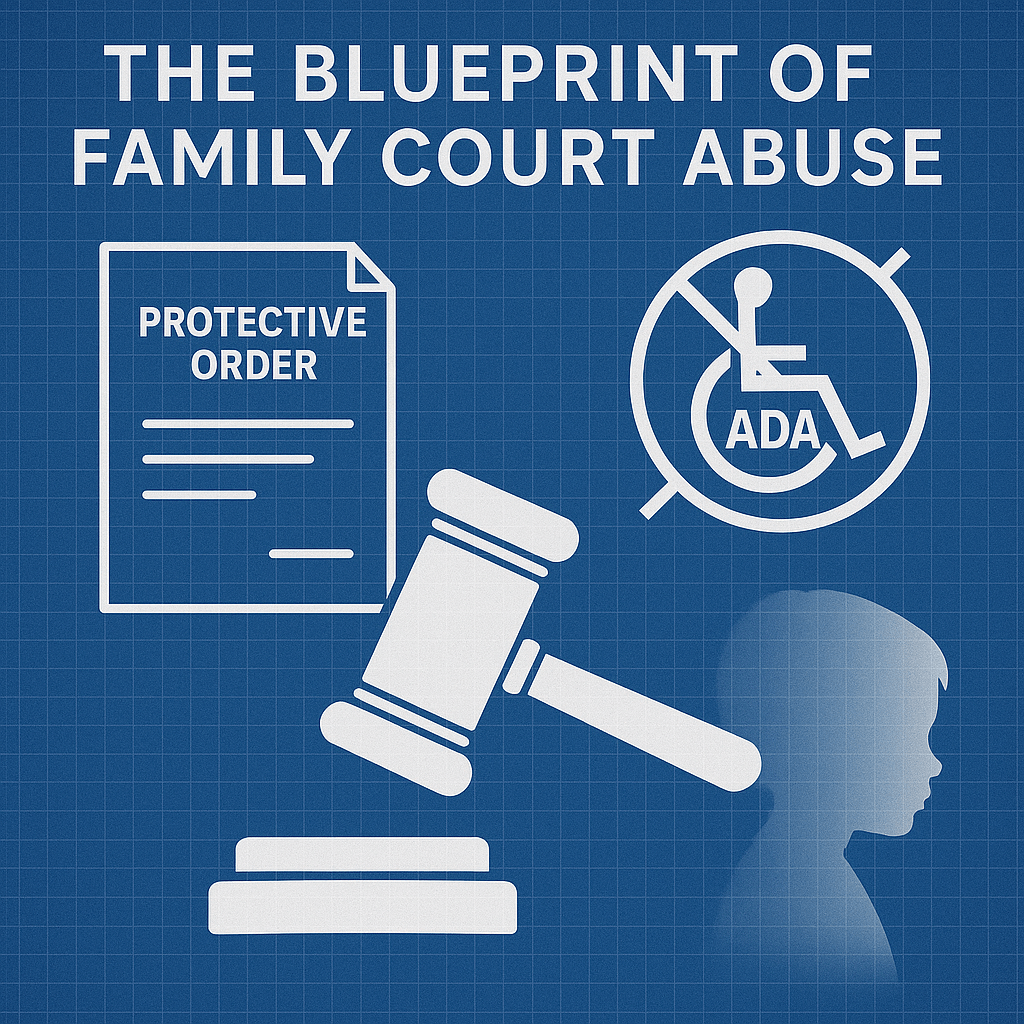
Step 1: Protective Orders as the Opening Salvo
Jeff Reichert’s nightmare began the way so many modern custody wars do—not with evidence, but with a piece of paper. Protective orders, originally designed to shield victims from genuine threats, have been hijacked as tactical nukes in family law. In Jeff’s case, allegations were enough to trigger life-altering restrictions, despite the absence of credible evidence or a criminal conviction. Once issued, these orders tilt the playing field so steeply that the targeted parent is already halfway to losing custody before they set foot in court.
This is no accident—it’s a playbook. Across the country, divorce lawyers coach clients on how to use protective orders to gain the “temporary” upper hand, knowing that in family court, “temporary” almost always turns into permanent. And because family courts operate in a legal grey zone, the accused parent often has fewer rights than a shoplifter awaiting trial.
Step 2: ADA Protections Ignored
Jeff is a disabled veteran. Under the Americans with Disabilities Act (ADA), he is entitled to reasonable accommodations in legal proceedings—whether that means scheduling flexibility, assistive technology, or the ability to participate remotely when mental health or medical needs require it. Yet time and again, Maryland’s family court ignored these obligations. Requests were delayed, denied, or outright dismissed.
This is not unique to Jeff. In courtrooms from California to New York, ADA accommodations are treated as optional favors instead of binding legal requirements. It’s systemic discrimination hiding in plain sight, disproportionately affecting disabled parents—many of them veterans—whose service to the country earns them less courtesy in family court than they’d get from the DMV.
Step 3: Venue Shopping and Judicial Bias
In Reichert v. Hornbeck, the case was moved to a jurisdiction that neither parent lived in—a move that defies both common sense and procedural fairness. Why? Because in the murky world of family court, venue shopping is a tool to keep cases in front of “friendly” judges. Once there, Jeff faced a carousel of jurists who denied motion after motion—too many to count—without addressing the merits.
This isn’t about one bad judge. It’s about a culture where judicial discretion becomes judicial activism, where the “best interest of the child” is twisted into a shield for arbitrary rulings that would never survive scrutiny in criminal or civil court.
Step 4: The Child as Collateral Damage
The ultimate victim here is not Jeff—it’s his son, who has been alienated from his father for over a third of his life. Despite thriving in Jeff’s care before the legal blitz, he has been cut off based on allegations never proven and orders never justified. This mirrors a national epidemic of parental alienation, where courts enable one parent to erase the other, ignoring the long-term psychological damage to the child.
And here’s the bitter truth: the system profits from it. The longer the fight, the higher the billable hours for attorneys, evaluators, and court-appointed experts. Justice is delayed, not because the facts are complex, but because prolonging the conflict keeps the meter running.
The National Blueprint
Jeff’s ordeal isn’t just a Maryland problem—it’s the national blueprint for family court abuse:
- Launch with a protective order — bypass the need for real evidence.
- Exploit judicial discretion — use venue shopping to land in a favorable court.
- Ignore federal law — sidestep ADA protections without consequence.
- Prolong proceedings — profit from years of litigation.
- Alienate the child — turn “temporary” separation into permanent erasure.
From coast to coast, this model plays out daily, leaving behind a trail of bankrupt parents, traumatized children, and a public too numb to notice.
The Call to Action
If America’s conservatives want to talk about restoring the rule of law, they can’t ignore the gulag of family court. We need:
- Protective order reform that restores due process.
- Mandatory ADA compliance with penalties for violations.
- Strict venue rules to stop jurisdictional abuse.
- Parental alienation recognition as a form of child abuse.
Because if the government can take your child on the basis of an unproven allegation, ignore your disability rights, and bankrupt you in the process, then the Constitution is nothing more than a suggestion.
Jeff Reichert’s case should be a wake-up call. It’s not just about one father. It’s about whether the principles of fairness, evidence, and equal protection still mean anything in the family courts of America.
Discover more from Reform Maryland Courts
Subscribe to get the latest posts sent to your email.
